
Start with the room your staff already complain about.
Odor burden is not spread evenly across a hospital. It concentrates in a handful of predictable places, and everyone who works there can name them without looking anything up. Those are the rooms Nebuscent is built for.
Six places odor concentrates in almost every facility.
Inpatient rooms
The core case. Wound care, ostomy output, incontinence and emesis all happen at the bedside, and the odor stays in the room with the patient, the family and the next clinician through the door.
Emergency department
Treatment areas turn over fast, bays are separated by curtains rather than walls, and there is rarely time to air a space out before the next patient is in it.
Wound and ostomy care
Among the most persistent odor sources in any facility, and among the most personally distressing for the patient, who is acutely aware of it and often apologizing for it.
GI and endoscopy
Preparation, procedure and recovery areas all carry a distinctive odor burden that patients and waiting families notice immediately on arrival.
Oncology and infusion
Patients undergoing treatment are frequently nauseated and hypersensitive to smell, which is exactly the population that fragrance-based products make worse rather than better.
Long-term and post-acute care
Residents live there. Families visit repeatedly and form a view of the whole facility from the corridor, which makes persistent odor a reputational issue as much as a comfort one.
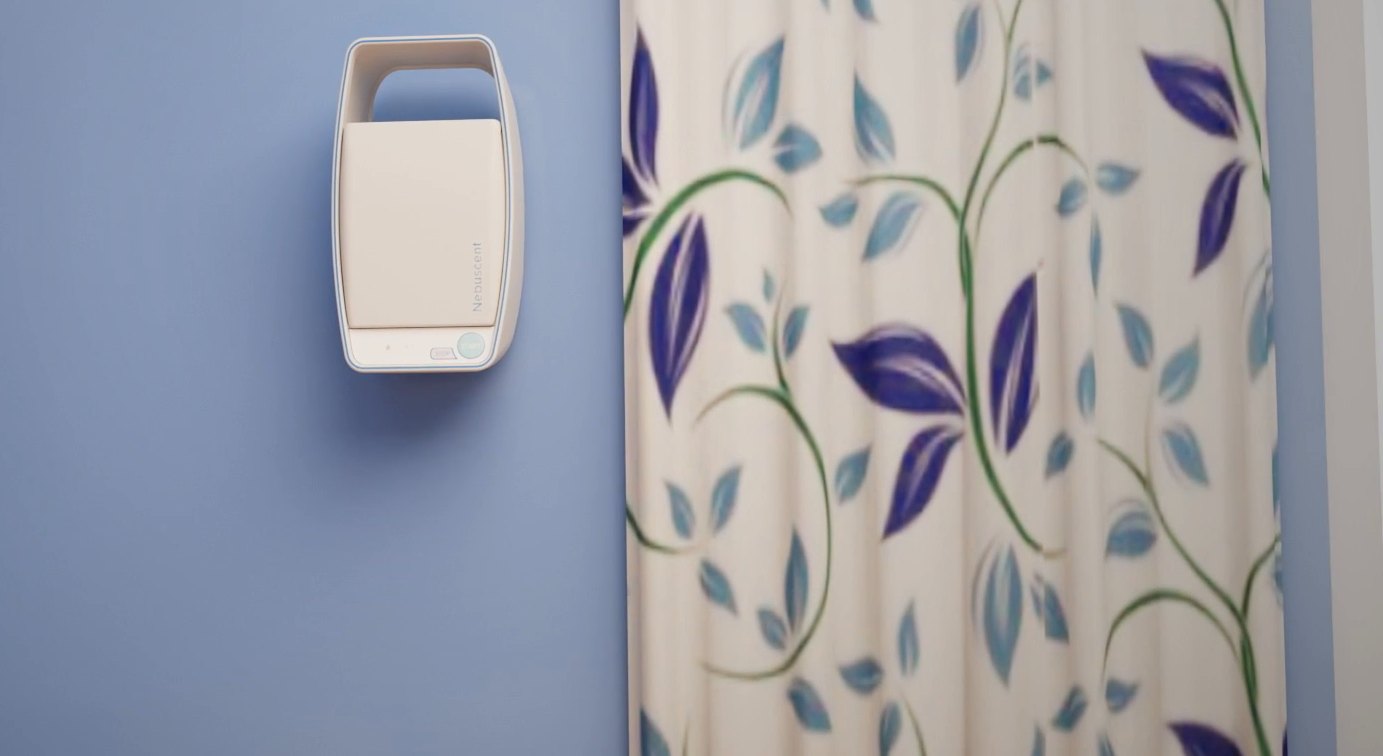
On the wall, out of the way, where nobody has to think about it.
The unit is sited on free wall space clear of the bed and the equipment rail, so it does not compete for an outlet or interfere with the way a room is worked. Because it is battery powered, placement is a clinical decision rather than an electrical one.
In practice most facilities put the first units in the rooms with the worst reputation, run them for a period, and let the staff in that unit decide whether it is working. That is a far more honest test than a specification sheet, and it is the one we recommend.
The same unit solves a different problem for each of them.
Patient experience
Perception of cleanliness is one of the things patients are actually asked about, and it is formed partly by what a room smells like. Nebuscent supports initiatives aimed at improving patient and visitor satisfaction, and may enhance perception of cleanliness and quality of the care environment, a marker evaluated by HCAHPS.
Environmental services
May help staff spend less time addressing odor-related issues and may reduce reliance on disposable odor masking products. It also supports faster return to service and less downtime for odor-impacted rooms.
Nursing and clinical staff
May improve staff experience in odor-sensitive clinical settings and help reduce workflow disruptions related to persistent odors, so attention stays on the patient rather than on managing the room.
These reflect the outcomes facilities pursue when they deploy Nebuscent. Results vary by facility, unit type and odor burden, and are not guaranteed.
Tell us which unit is the problem.
Name the floor with the reputation. We will talk through what a first placement there would look like and what it would take to judge it fairly.