
Clinically tested. Hospital proven.
Odor is subjective, which is exactly why it should be tested in front of the people who have to live with it. Nebuscent was evaluated inside a working hospital, in occupied rooms, under a protocol that hospital's own review board approved.
What was actually tested, and where.
IRB approved
The evaluation was reviewed and approved by the institutional review board of a large U.S. healthcare system before it began.
Real hospital setting
Clinically validated in real-world hospital environments rather than in a sealed chamber or a simulated room.
Active patient rooms
Evaluated in rooms that were in use, with the ordinary movement of air, staff and equipment that a real room has.
Staff reported
Demonstrated strong staff-reported effectiveness in odor elimination, assessed by the people who work in those rooms.
A chamber test proves a chemical reaction. It does not prove a room smells better.
Most odor products are validated against a single reference compound in a sealed vessel, at a fixed concentration, with an instrument reading the result. That tells you something real about the chemistry and almost nothing about a hospital.
A patient room is the harder problem. The odor source is often ongoing rather than a one-off release. Air moves constantly. Doors open. And the verdict that matters is delivered by a nurse who walks in and decides, in about a second, whether the room is acceptable.
Evaluating in active patient rooms, and asking staff whether the odor was actually gone, tests the product against the standard it will be judged by in service.
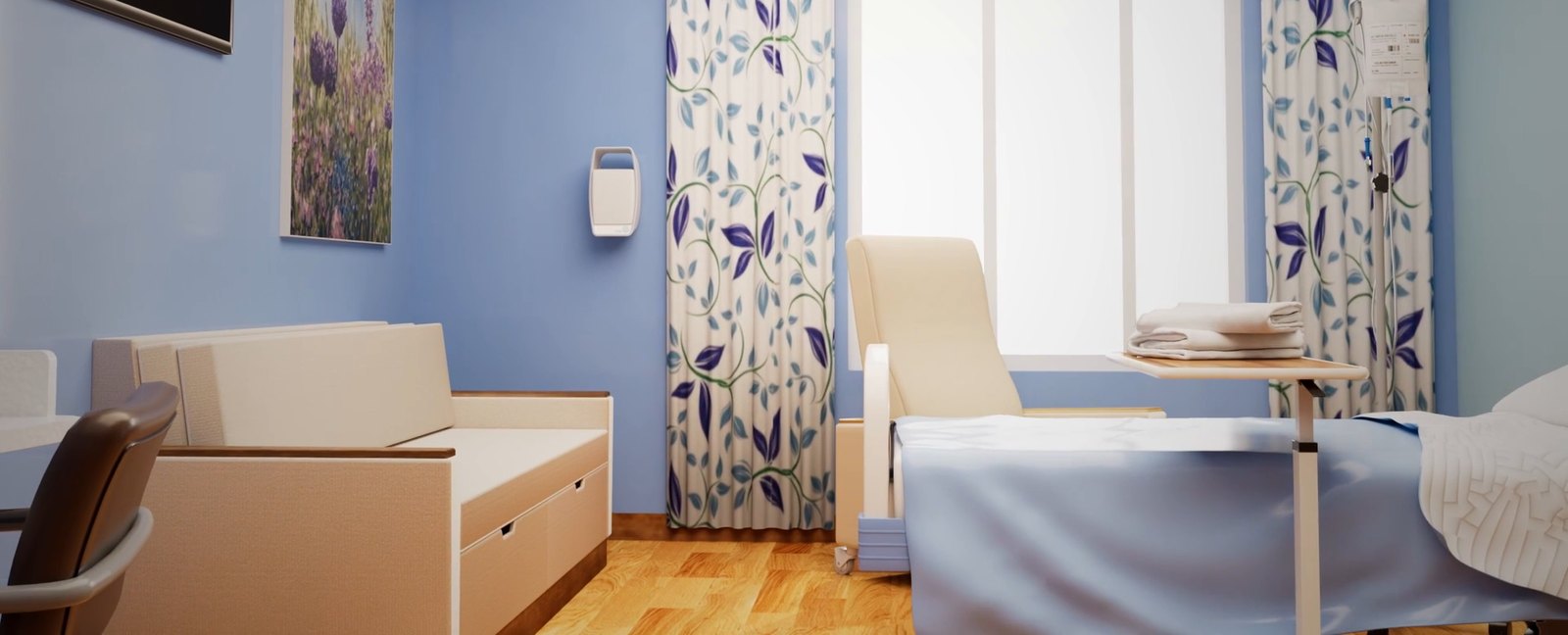
Why the environment shows up on the scorecard.
HCAHPS, the national patient experience survey used across U.S. hospitals, asks patients directly how often their room and bathroom were kept clean. Those responses are publicly reported and they carry money. The Person and Community Engagement domain, which is built from HCAHPS, accounts for 25 percent of a hospital's Value-Based Purchasing Total Performance Score, and that program is funded by a 2 percent withhold on inpatient operating payments, estimated at roughly 1.7 billion dollars for FFY 2026. Cleanliness is one of eight HCAHPS dimensions feeding that domain today, and its share rises from one eighth to one sixth from FY2027.
Odor is one of the strongest signals a person uses to judge whether a space is clean, and it is judged before anyone reads a chart or meets a clinician. A room can be cleaned to protocol and still fail that instinctive test if the smell has not gone anywhere.
Nebuscent is positioned squarely at that gap: it does not replace any cleaning process, it deals with what remains in the air once cleaning has been done correctly.
Unlike traditional air fresheners that simply mask odors, Nebuscent eliminates them at the molecular level.
What the literature already establishes about odor in care.
Nebuscent's own evaluation sits inside a wider body of research. These are not our findings, they are the published ones, and every figure below is linked to its source so you can check it.
One in four inpatients does not say their room was always clean
Across 3,949 hospitals, the national top-box score for cleanliness of the hospital environment is 74 percent. The spread is the more useful number: 88 at the 95th percentile against 59 at the 5th, a gap of 29 points between the best and worst performers on the same question.
CMS also publishes a patient-level correlation matrix built on 2.2 million surveys. Cleanliness correlates with the overall hospital rating at r = 0.44 and with willingness to recommend at r = 0.39. To be straight about it, cleanliness is not the strongest driver, communication with nurses leads at 0.66, but cleanliness ranks ahead of both quietness and discharge information.
HCAHPS national published results, CMS
Odor is the symptom stoma patients say restricts their life most
A 2022 study of 2,262 rectal cancer survivors across five countries found leakage reported by 58 percent and troublesome odour by 55 percent, ahead of skin problems and pain. Odour was the single strongest predictor of feeling restricted in daily life, with an odds ratio of 2.74.
Krogsgaard et al., Supportive Care in Cancer, 2022
Almost nobody is managing it, because there has been nothing to manage it with
A survey of 1,444 clinicians across 36 countries found that only 12 percent routinely assess wound odour, and that of those using charcoal and silver dressings, just 48.4 percent and 23 percent respectively considered them very effective. The authors describe a trial and error approach with low overall satisfaction.
Gethin et al., Current practice in the management of wound odour, International Journal of Nursing Studies, 2014
It changes how clinicians behave at the bedside
This is the finding that should concern any facility. Research on disgust in clinical care describes it as a common emotion among healthcare professionals which, in extreme cases, contributes to neglect, and which is typically hidden away as a silent part of care. A 2025 study of intensive care nurses found high disgust responses to vomit, faeces and sputum, and that those nurses scored significantly lower on measured caring behaviours (Nursing in Critical Care, 2025).
Hadjittofi et al., The experience of disgust by healthcare professionals, International Journal of Nursing Studies, 2020
These studies concern odor in healthcare generally. They are cited as context for the problem Nebuscent addresses and are not evaluations of Nebuscent itself. Nebuscent makes no infection prevention claim of any kind, and perceived cleanliness should not be read as a measure of infection control.
Request the evaluation summary.
Facilities assessing Nebuscent formally can request the evaluation summary, safety documentation and regulatory information for review by their own clinical, EVS and procurement teams.
Nebuscent is an odor management system. It is not a medical device and is not intended to diagnose, treat, cure or prevent any disease. It is not a disinfectant, sanitiser or infection-control measure and does not replace any cleaning or infection-prevention protocol. Descriptions of benefits reflect evaluation findings and facility-reported outcomes, and individual results vary.