
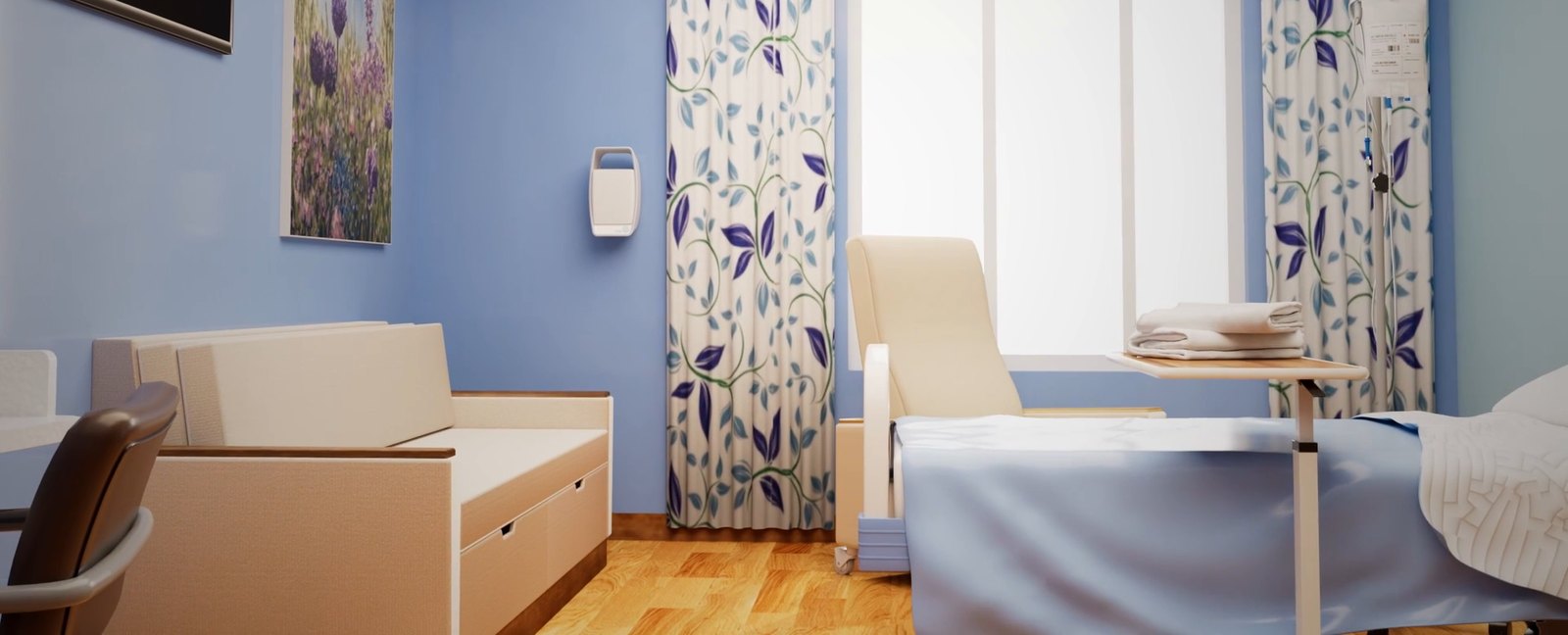
A hospital should be remembered for its care.Not for how the room smelled.
Nebuscent is an odor management system engineered for patient care areas. Press start and it breaks malodor down at the molecular level, then stops on its own. No fragrance. No aerosol. Nothing masked.
Odor is the one thing every visitor notices and no one is assigned to fix.
Wound care, ostomy output, incontinence, GI procedures, emesis. The clinical work is routine. The smell it leaves behind is not, and it lingers in the room long after the task is finished.
Staff improvise. A towel over a bin, a door propped open, a canister of air freshener bought out of pocket. It works for a few minutes, and then the room smells like flowers over the top of the original problem, which everyone can still identify.
Meanwhile a family is sitting in that room forming a permanent opinion about the quality of care their mother is receiving.
The last thing a patient and their family should experience is a foul-smelling environment.

One button. Three steps. No workflow to redesign.
Nebuscent was built to be used by whoever is already in the room, without training, PPE, or a call to another department.
Press start
The unit sits on the wall, out of the way of the bed and the equipment rail. A single press begins a cycle. There is a stop control if the room needs it sooner.
The odor is broken down
The cartridge solution disperses and binds malodor molecules already in the air, breaking them apart rather than laying a fragrance over them. Relief is noticeable within seconds.
It stops by itself
The cycle ends automatically. Nothing to time, nothing to switch off, nothing left running when the room turns over.
Masking an odor and removing one are different jobs.
Everything a hospital currently reaches for is designed to sit on top of the smell. Nebuscent is designed to take it apart.
Sprays, plug-ins and gel canisters
- Add a fragrance on top of the malodor, so both are present
- Aerosols and heavy scents around patients who may be nauseated or sensitive
- Consumable products bought repeatedly, often off-contract
- Effect fades in minutes, and the room reverts
Nebuscent
- Captures and breaks down malodor at the molecular level
- No added scents, fragrances, aerosols or essential oils
- One fixed unit, one long-lasting cartridge, a predictable line item
- Cartridge solution formulated from natural ingredients to meet healthcare regulatory standards
Designed to disappear into the room.
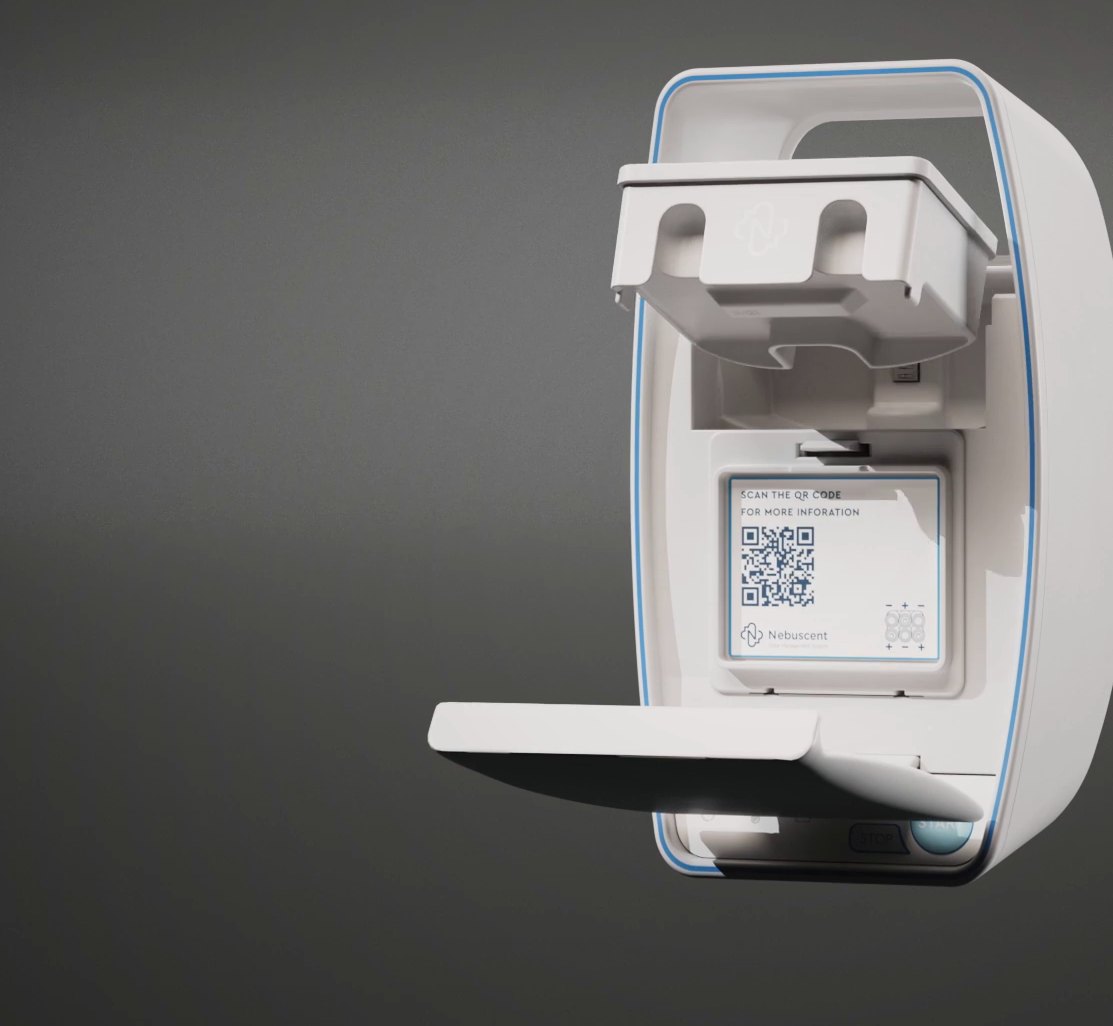
A sealed wall unit and a replaceable cartridge. Nothing clinical to maintain, nothing that reads as equipment.
The unit
Wall mounted and low profile, sited clear of the bed and the equipment rail. Battery powered, with the option to plug in where a facility prefers it.
The cartridge
Long lasting and replaced without tools, typically once or twice a month depending on how heavily the room is used. Each cartridge carries a code so stock is tracked, not guessed.
The cycle
Simple start and stop. Once activated the system works discreetly and shuts off on its own, so a room that has turned over is not left running.
Environmental services should not need a procedure for this.
Odor control usually falls to whoever is nearest, which in practice means EVS and nursing staff solving it with whatever is in the supply closet. Nebuscent replaces that improvisation with one consistent action anyone can take.
- No training burden. If someone can press a button, they can run the system.
- No PPE or handling requirements beyond a routine cartridge change.
- Nothing to reorder ad hoc. One cartridge on a predictable replacement cadence.
- Rooms return to service sooner when odor is no longer the reason a bed is held back.
Tested where it has to work, not in a lab that smells like nothing.
Nebuscent has been clinically evaluated under an IRB-approved protocol within a large U.S. healthcare system, in active patient rooms, with staff reporting on whether the odor was actually gone.
That distinction matters. An odor product can perform well against a single test compound in a sealed chamber and still fail in a real room, where the source is ongoing, the air is moving, and the people judging the result are the ones who work there every day.
IRB-approved protocol
Reviewed and approved by a large U.S. healthcare system before evaluation began.
Active patient rooms
Evaluated in rooms in real use, not simulated or vacant test space.
Staff-reported effectiveness
Demonstrated strong staff-reported effectiveness in odor elimination.
It was built by someone who kept walking into the problem.
Nebuscent came out of emergency medicine. Dr. Aarian Afshari trained at Emory University School of Medicine and Grady Memorial Hospital's Marcus Trauma Center, one of the busiest Level 1 trauma centers in the world, and spent years in departments where malodor was a constant and there was never a good answer for it.
Unpleasant odors shouldn't shape perceptions of care. Yet they can.

Put it in one difficult room and see what happens.
The fastest way to judge Nebuscent is to place it in the unit that has the worst reputation for odor and ask the staff there what changed. Tell us about your facility and we will arrange it.